Wear a necklace over your hoodie if you want to show it and can leave clear space between the jewelry, drawstrings, and zipper. Wear it underneath if you prefer a small detail at an open neckline, or if the necklace keeps crossing the hardware on the front. Choose the position with your actual hoodie on before deciding whether you need a different chain length.
A plain pullover gives you a different starting point from a zip-up worn over a T-shirt. Use the opening and the details already on your sweatshirt to decide where the necklace should sit.
Over or Under a Pullover Hoodie?
For a visible necklace, try it over a plain pullover with the pendant or lowest strand below the neck opening. Leave a gap between the necklace and the collar rather than resting the pendant halfway across the seam. With a black or charcoal sweatshirt, you could use white beads or silver-colored hardware for contrast.
Look at the drawstrings next. If they cross the necklace, move them to either side and see whether you like the result. If you keep rearranging them, try a simpler necklace, a hoodie without drawstrings, or jewelry underneath. You do not need to make a crowded neckline work.
Wearing the necklace underneath suits a quieter look. A closed pullover may hide it; you can still wear a piece you like without displaying all of it. Avoid choosing a longer chain just to force a pendant out through a small neck opening.
With a Zip-Up, Use the Opening
Try a zip-up partly open over a plain T-shirt, with the necklace over the T-shirt and inside the sweatshirt. Keep the pendant within the opening so that you can see its shape without moving the zipper aside.
Zip the sweatshirt to the height you normally wear. If the zipper pull and pendant meet in the same spot, change the necklace length or the opening, or choose one visible detail. For an open zip-up and a graphic tee, place the pendant away from the part of the print you want to keep visible.
Choose Length by Placement, Not a Universal Number
Put on the hoodie you plan to wear and mark where you want the lowest part of the necklace to rest. Use a necklace you already own as a reference. A listing's total length will not describe the whole result if the design also includes a pendant, hanging charms, or several strands.
Before ordering, ask for the wearable length range and the distance from the main strand to the lowest hanging detail. Check how you fasten and adjust it. An "adjustable size" label alone does not tell you whether the necklace reaches your chosen position over a thick sweatshirt.
For broader fit questions, our guide to choosing a comfortable statement necklace covers placement and everyday movement. Here, the extra decision is how that fit changes when you add the hood, neck opening, and front hardware.
Pair a Detailed Necklace With a Plain Hoodie
If you want beads, chains, and charms, start with a solid-color hoodie and leave other necklaces out of the first outfit. Try straight-leg jeans and simple shoes, then decide whether you want more detail. With a large chest graphic, a small pendant above the print may be easier to place than several hanging strands over it.
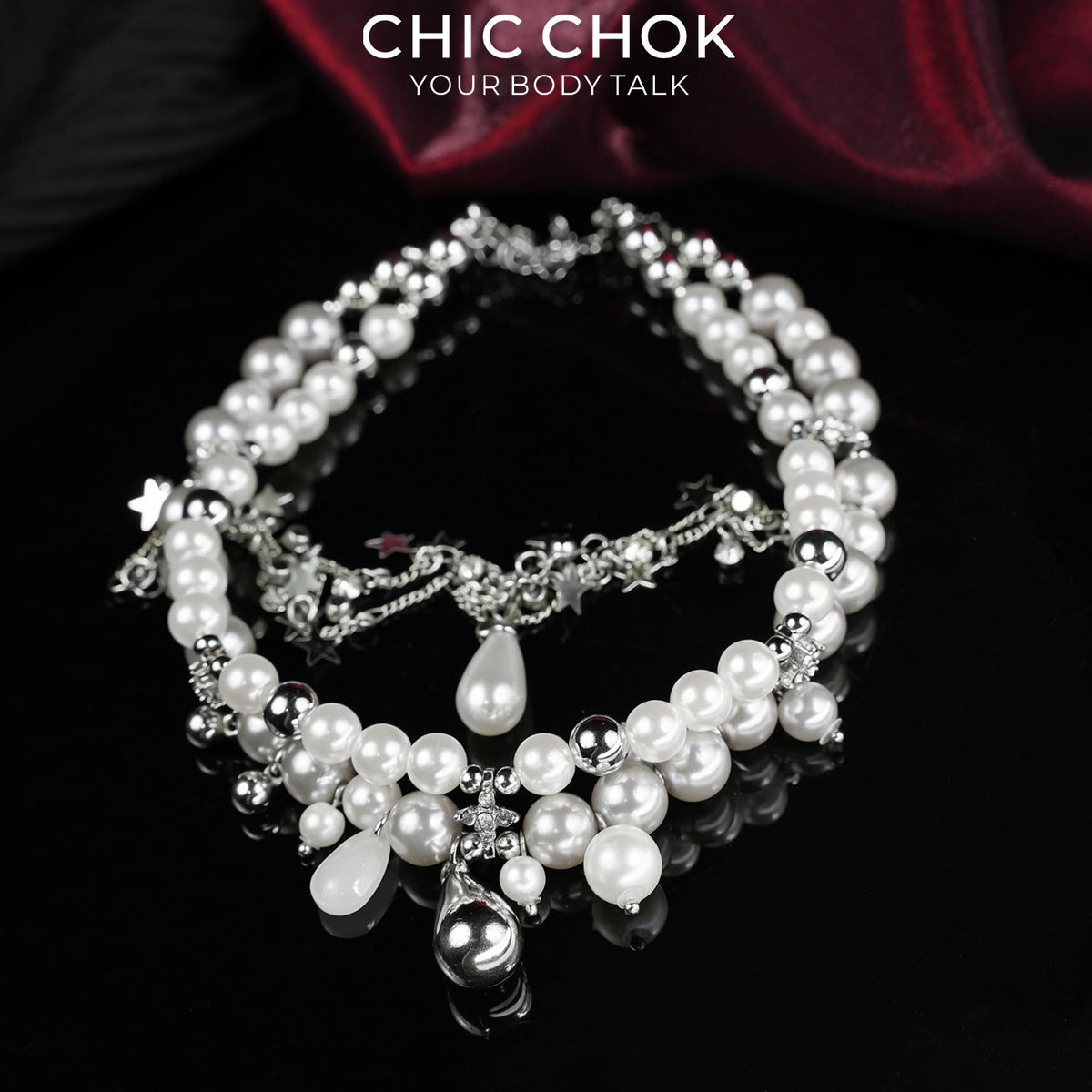
The Fractured Cloud necklace offers one detailed example: its catalog photo shows white beads, silver-colored chains, and star-shaped charms. Consider it with a plain dark pullover if you want those details visible. The photo does not show the necklace over a hoodie, so confirm the length range and fastening before choosing it for that outfit.

Check the Hood Before Heading Out
Raise and lower the hood, look down, and sit in the outfit. Check whether the necklace stays where you wanted it or crosses a drawstring, zipper, or collar. If you need to keep repositioning it, change the placement or leave it off.
Remove the necklace before pulling the hoodie over your head. If a charm catches, stop and free it rather than tugging the sweatshirt through it. For an easy starting outfit, choose either a visible necklace over a plain pullover or a necklace over a T-shirt inside an open zip-up. Add more detail only after you like that placement.